2025 Year in Review


By Marlies Bockstal
2025 IAVS blog editor
PhD Student at New Zealand Centre for Human-Animal Studies, Aotearoa New Zealand
marlies.bockstal@pg.canterbury.ac.nz


It’s the end of 2025 and this marks the close of the 6th year of the International Association for Vegan Sociologists. It’s wonderful to see this international vegan sociology community growing every year. We now even have over 600 signups, too many to keep our monthly newsletter going for free. But we consider that a good problem! We’ll have to find more creative ways than the newsletter, or find a way to keep it going, to keep you all in the loop about everything that’s happening within our community and interesting opportunities. But rest assured, we will also keep you updated via social media and our website of course. You can reach out to us if you want us to promote any new research or announcements at any time!

Our 6th annual IAVS free online conference the first weekend of October was also a success. We saw a lot of our regular attendees and some new faces as well, including some vegan activists from Romania. It’s so great to see that we can connect vegan activists with vegan sociology academics, creating meaningful connections between the worlds of academia and activism. We even had Kate Steward and me (Marlies) baking some vegan goodies together on Sunday. We started joking that we should hold a baking presentation session next year. Maybe we will. Too bad we can’t hold a taste panel online. Hopefully we can hold it in person, some day. In addition, we were able to listen to a moving poetry interlude by Maria Martelli. It truly was a conference about senses and emotions.

This year, the Australasian vegan sociologists started weekly Shut up & Write (SUAW) sessions to connect with each other on a regular basis as it can be lonely sometimes to be a vegan sociologist. Even though the goal is to shup up and get some writing done, sometimes there tends to be more talking than writing done. But sometimes that’s what you need. The hour difference makes it challenging for the European time zones to join in so we’re looking to possibly add another SUAW at a different time.

We’ve also had some interesting blog posts this year based on our members research, going from the promotion of veganism on social media and how the Animal Agriculture Industry counters campaigns promoting dietary change to questions about greyhounds as ‘pets’ and decolonial and intersectional veganism. We’re accepting new ones at any time so if you want to turn your own research, ideas, conference presentation into a blog post, you can reach out to us to get this posted on our blog!

Next year, we’re hoping to start up some other initiatives such as a “Research Lab” for (Postdoc) researchers, vegan sociology meetups in person, more SUAW sessions, and maybe even rebooting our podcast. We’re looking for people to take the lead on such initiatives. So, don’t hesitate to reach out if you want to be involved!

Lastly, a special shout out to Alex, Libby and Stephen of our IAVS committee for the commitment the past year. Thank you for all your meaningful work! And as always, thank you to Corey and Zoei for being such amazing and inspiring leaders of IAVS and for keeping this vibrant IAVS community going!

It’s been a pleasure being your blog editor for this year.

Thank you all for being involved in your own unique ways.

We hope we’ll see you at the next conference on October 3 & 4 on Internationalising Vegan Sociology! You can already submit your abstract, if you want to be a very early bird 😉

Warm wishes,

Marlies 🌞
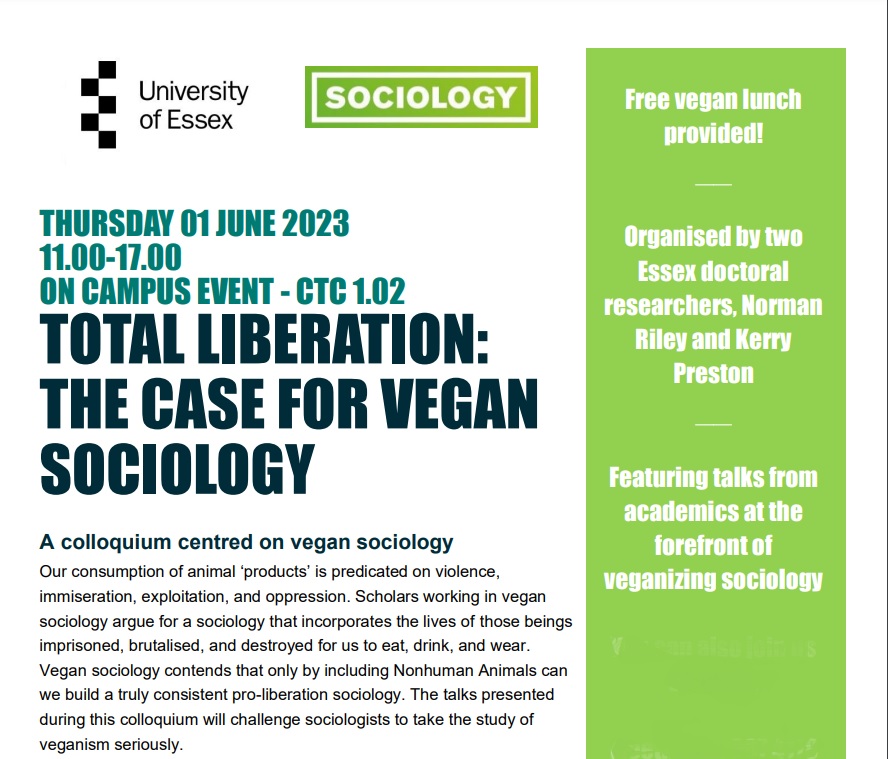
Total liberation: The case for vegan sociology.


Sociology colloquium Thursday 01 June 2023

Dear colleagues,

We are delighted to invite you to a colloquium centred on vegan sociology. Organised by two Essex doctoral researchers, Kerry Preston and Norman Riley, the day will feature talks from academics at the forefront of veganizing sociology. A free vegan lunch will be provided!

Our consumption of animal ‘products’ is predicated on violence, immiseration, exploitation, and oppression. Scholars working in the field of vegan sociology argue for a sociology that incorporates the lives of those beings imprisoned, brutalised, and destroyed for us to eat, drink, and wear. Vegan sociology contends that only by including Nonhuman Animals can we build a truly consistent pro-liberation sociology. The talks presented during this colloquium will challenge sociologists to take the study of veganism seriously.


When:              Thursday 01 June 2023 from 1100 to 1630

Where:             CTC 1.02 and online


Speakers are:

1100-1200: Dr Corey Lee Wrenn, a sociologist and scholar of social movements and human-nonhuman relations based at the University of Kent, will present her talk What is Vegan Sociology?

1200–1300: Dr Matthew Cole is a Lecturer in Criminology at the Open University. Dr Cole will discuss his contribution to Human-Animal relationships in times of pandemic and climate crises: multispecies sociology for the new normal, edited by Josephine Sutton and Zoei Sutton, and due to be published by Routledge later this year.

1400-1500: Norman Riley will present Choose life: The liberatory potential of political veganism

1500-1600: Dr Kate Stewart, Associate Professor in Sociology at the University of East Anglia, will present her talk Vegan Sociology and the endangered emancipatory purposes of the University.

1600: Open discussion


Speaker abstracts are attached to this email

Please do join us for what will be a day of informative discussion and debate on this nascent and exciting field of study.

Register here or see the flyer

We look forward to seeing you on June 1st.


The World is On Fire – Vasile Stănescu

On March 25th, IAVS affiliate Dr Vasile Stănescu from Mercer University spoke to the University of Kent’s School of Social Policy, Sociology and Social Research. He gave an impassioned talk to an audience of 80 on the politics of climate change, the silence on animal agriculture’s contribution to the environmental crisis, and major tactical failings of the animal rights movement.

Watch here >>

Abstract below.

The World is on Fire: Animal Agriculture, Climate Change, and the Path Forward

In 2006, the UN’s Food and Agriculture Organization (FAO), issued a report titled “Livestock’s Long Shadow,” concluding that animal farming presents a “major threat to the environment” with such “deep and wide-ranging” impacts that it should rank as the leading focus for environmental policy. Recently, these stakes were raised again when the UN determined that the world has only fourteen years to act to prevent catastrophic effects due to climate change. The UN Convention on Biological Diversity estimates as high as 150 species go extinct each day; the UN determined animal agriculture represents the single largest cause of habit loss, species extinction, and biodiversity loss. Most importantly, exponentially more animals are killed, in worse conditions, every year: My first publication in critical animal studies, entitled “Green Eggs and Ham: The Myth of Sustainable Meat and The Danger of the Local” was published in 2010; at that time, the world raised and killed approximately 60 billion land animals each year. Today it is 80 billion; the UN estimates by 2050, the number will exceed 120 billion. The world is on fire.

The response by many, including both advocates for animal agriculture and animal rights, has been three main strategies:

  • Attempts to move toward local, humane, and free-range animal farming based on, in part, a belief that such moves will positively affect the environment
  • The rise of so-called “in vitro” meat which, like claims about humane meat, will also offset the environmental effects of animal agriculture
  • Market based moves to sell new meat substitutes, such as Burger King’s decision to sell the Impossible Whopper.

However, in reality none of these proposed solutions will work. Indeed, most – if not all – will in reality make the environmental effects of animal agriculture worse. Instead, I argue, we need a social justice based approach to animal advocacy, based on directly confronting speciesism and anthropocentrism, that seeks to build solidarity between animal rights and other social justice movements to affect broad based change. We are running out of time. To paraphrase the famous maxim attributed to Marx: As scholars, we no longer possess the luxury to only understand the world; we have to change it.

What is Vegan Sociology?


To celebrate our 1 year anniversary and the upcoming 2nd annual meeting of the International Association of Vegan Sociologists, we are compiling a short video montage featuring contributions from you to define and diversify our field.

Where does our field come from? Where is it going? What do you believe it can achieve? 

Please submit a few sentences or a short video clip explaining what vegan sociology means to you. 

Help us shape our discipline!

Submit to:
info@vegansociology.com

Announcing Our New Guiding Principles and Student Journal


“Sociology is part of the seeing of other animals and, although still somewhat marginal to sociology, that sociological seeing is changing things in sociology. However, it is not just seeing other animals that should be a central component of sociology; the role of sociology in countering the oppression of other animals is also pertinent.”

– Kay Peggs, Animals and Sociology (Palgrave 2012)


Dear colleagues, 

We are so pleased to announce the release of our guiding principles. These were designed collaboratively by vegan sociologists the world over. We expect they will be useful for students, researchers, and regional sociological associations. 

We are also announcing the launch of our annual student journal. We’re currently seeking student (graduate and advanced undergraduate) volunteers for the editorial board as well as submissions by February of next year. We expect this will provide an important opportunity for service work, networking, and professional training.