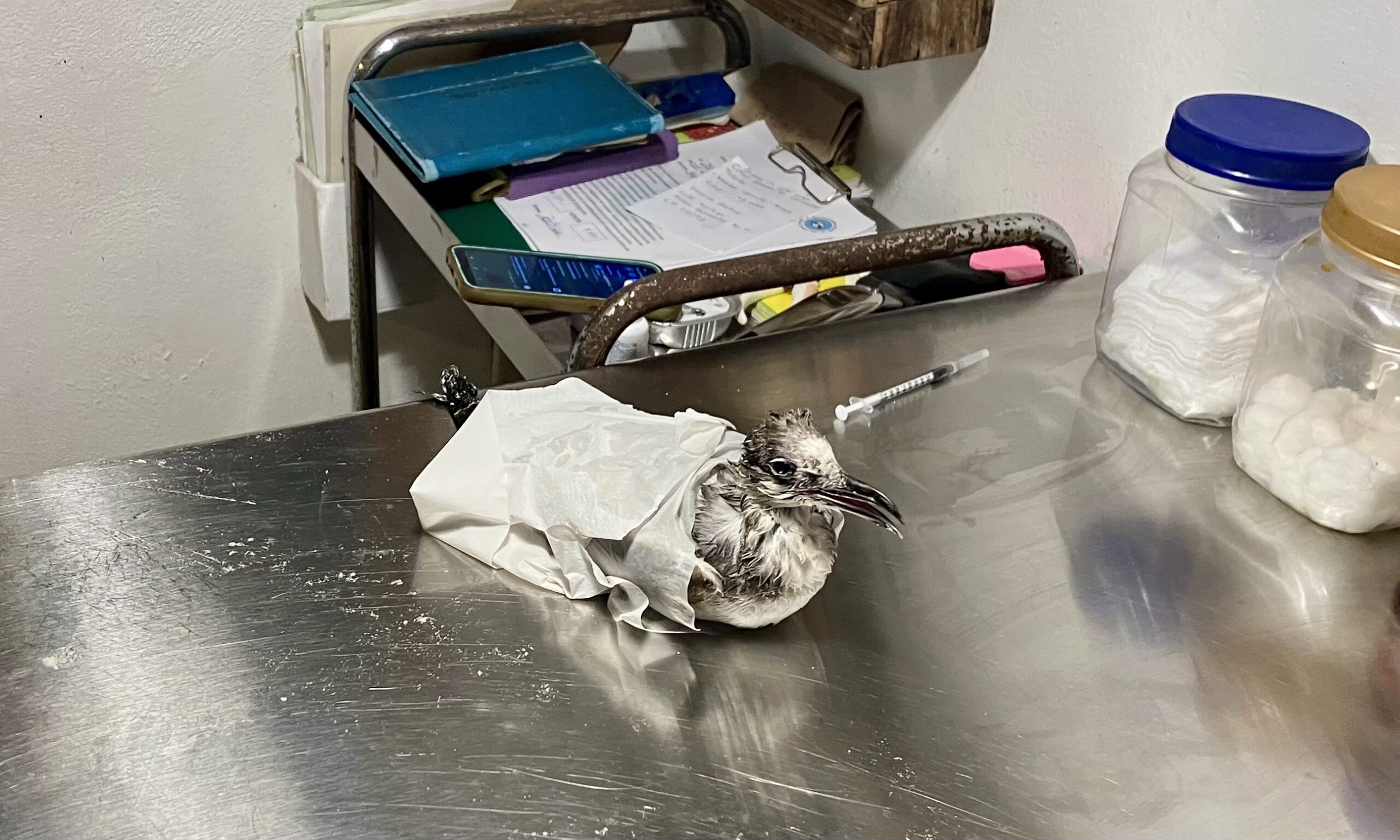
Rescuing Ms. Nelly: What One Seagull Taught Me About Vegan Sociology

Peter J. Marina

I was meditating on Holbox beach after sunset, sitting by a wooden walkway as waves rolled in with the evening tide. Then I heard it: a seagull’s distress call. I tried to ignore it at first, to “let nature take its course.” But the second panicked cry changed everything.

I jumped into the crashing waves to find a helpless seagull surrounded by five or six raccoons moving in for the kill. She was in shock but alive. I scooped her up, held her against my chest, and ran.

“¡Ayúdame! ¡Ayúdame!” I screamed, bursting into a beach bar full of tourists. They gave vague directions to a vet clinic, probably closed. It had rained all day, and Holbox’s unpaved streets had become rivers. I ran through waist-deep floodwater, desperately searching for the clinic, taking wrong turns, hoping I wasn’t too late.

After thirty minutes, I found it: an animal rescue normally closed at that hour. By chance, they were open because a mother dog had complications giving birth. I banged on the door, screaming for help. When they opened, I handed them the seagull and emptied my entire wallet onto their table without counting. “Please, save her.”

They promised they would.

Two months later, I returned to find Ms. Nelly had spent six weeks there “on vacation,” eating, healing, resting. My money had paid for it all. Then she flew away, healthy and free.

This moment crystallizes why I became a sociologist: to understand how power determines which lives matter. Why did I run through floodwaters for one seagull when billions of animals suffer systematically every day? Because in that instant, Ms. Nelly wasn’t an abstraction. She was a terrified, sentient being whose life had inherent worth.

This is vegan sociology’s foundation: recognizing that the structures of domination exploiting humans also commodify and destroy non-human animals. At Holbox, I witnessed capitalism treating animals as resources: tourism disrupting ecosystems, fishing industries destroying habitats, strays abandoned when no longer “cute.” The sanctuary exists because our economic system creates endless animal suffering, then abandons the casualties.

But I also saw resistance. People dedicating their lives to rescuing animals who will never “produce” anything. This is Mills’ sociological imagination in action: connecting personal troubles (one injured seagull) to public issues (systemic violence against animals).

Vegan sociology extends critical analysis beyond human society. The hierarchies creating racism, sexism, and class exploitation also normalize speciesism. Walking through any city, I see dead animals everywhere: on plates, in leather, in cosmetics. People consume what advertisers conditioned them to want, rarely questioning the violence required.

But sanctuaries like Refugio Animal Holbox on this Mexican Caribbean island create spaces outside capitalist logic, where animals aren’t commodities but neighbors. Where Ms. Nelly’s recovery mattered because her life had inherent worth, not because it served human interests.

I now volunteer at that sanctuary every time I return to Holbox. I think about Ms. Nelly constantly, still out there somewhere, living free from the systems that nearly killed her. That’s the world vegan sociology imagines: one where all beings can simply live.


Peter J. Marina is a New Orleans native, sociologist, and criminologist, and an Associate Professor of Sociology and Criminology. Trained at the New School for Social Research, Marina’s scholarship focuses on urban ethnography, transgression, and social inequalities, with particular attention to human rights, policing, and communities living on society’s margins. He is the author of Human Rights Policing: Reimagining Law Enforcement in the 21st CenturyDown and Out in New Orleans, and several other books and articles. Marina’s thinking examines

How Veganism is and Always Should Be: A Critique of a Practice-based Definition of Veganism


By Nathan Poirier

In 2021, political scientist Jan Dutkiewicz and religious studies scholar Jonathan Dickstein wrote an article titled The ‘Ism’ In Veganism: The Case for a Minimal Practice-based Definition arguing that veganism should be restricted to refer to one’s personal habits only. I cited this article in my own article in the second issue of the Student Journal of Vegan Sociology (Poirier, 2023) but only in passing voiced my opposition to it. This post extends that sentiment by pondering this in relation to vegan sociology. As a sociologist, I find such a stripped-down definition of veganism unacceptable on many fronts. 

The assertion that veganism be applied to personal practice only is perhaps most fundamentally problematic due to who wrote the article. Dutkiewicz and Dickstein are both white male academics. While not necessarily problematic in itself, it is when one considers that many vegans of color consistently insist that veganism is much more than a diet, part of a lifestyle that extends to decolonisation, anti-racism, being pro-LGBT+, among other things. My favorite sources for such information are the edited books by Julia Feliz [Brueck] (Feliz Brueck, 2017; Feliz Brueck, 2019; Feliz Brueck and McNeill, 2020). In light of these viewpoints, a direct and self-proclaimed “minimal” definition of veganism becomes highly suspicious. This article was also published after quite a few sources on veganism of color had been published. Considering the number of definitions and takes on veganism Dutkiewicz and Dickstein cover in their article, there is no excuse for shunning these voices. 

In sociology, the positionality of a speaker matters, and the positionalities of those whose voices are being silenced matter too. Dutkiewicz and Dickstein write from privileged positions in addition to their hegemonic identities: both are research professors, jobs that come with cushy benefits, high salaries, considerable time off, and social prestige. Marginalising the already marginalised is not a difficult thing to do when one occupies such a socioeconomic position. But it is bad form, especially from a vegan sociology perspective. 

Anyone who studies veganism knows that the term has always been about more than personal lifestyle choices. Veganism can impact one’s political orientation, relationships and sexuality, consumption behaviors, activism, and much more. Veganism is about not exploiting others. In some sense, it is that simple. By the same token, it is also that complicated. It is not easy to recognise that all oppressions are connected as this is intentionally kept hidden by “the powers that be” and to take the steps to try to resist them altogether through consistent anti-oppression. One has a lot to lose socially in doing so, especially white males. 

Dutkiewicz and Dickstein do not argue for replacing the political and radical thrust of veganism with anything else that might get at the interconnection of oppressions. This is not of particular concern to them. What have they got to lose by reducing the radical thrust of veganism? In fact, taking a conservative stance within academia is typically rewarded. By removing something like activism or wider social awareness from veganism, the authors play it safe and protect their institutional statuses and jobs. 

I haven’t seen anyone make a direct and public critique of this article. Admittedly I was hesitant to write this because it calls attention to what I consider to be an erroneous, racist, and hurtful argument. But I do think veganism must be defended in its radical glory. A minimal practice-based definition made by two white people just seems a little too similar to white people calling for an end of teaching critical race theory (Kaepernick et al., 2023) or movements in animal advocacy spaces towards racist effective altruism. Vegan sociologists should stand behind a consistent anti-oppression definition of veganism and make it clear that a minimal practice-based definition is incorrect. No one should sit back quietly while two highly privileged people publicly and categorically silence vegans of color. 


References

Dutkiewicz, J. and Dickstein, J. (2021) ‘The Ism in veganism: The case for a minimal practice-based definition’, Food Ethics, 6(2), pp. 1-19.

Feliz Brueck, J. (2017) Veganism in an Oppressive World: A Vegans of Color Community Project. Sanctuary Publishers.

Feliz Brueck, J. (2019) Veganism of Color: Decentering Whiteness in Human and Nonhuman Liberation. Sanctuary Publishers. 

Feliz Brueck, J. and McNeill, Z. (2020) Queer and trans voices: Achieving liberation through consistent anti-oppression. Sanctuary Publishers.

Kaepernick, C., Kelley, R. D. G., and Taylor, K. (Eds) (2023) Our history has always been contraband: In defense of Black studies. Haymarket Books.

Poirier, N. (2023) ‘Three Sociological Paradoxes of Eating Animals’, Student Journal for Vegan Sociology, 2, pp. 41-52.