By Vasile Stănescu
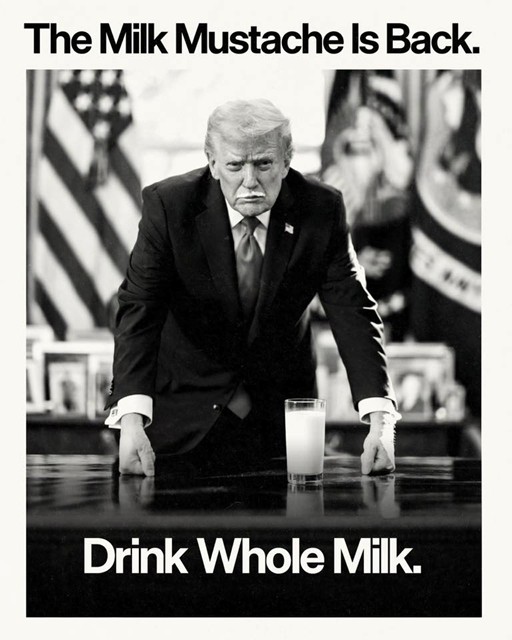
When the White House posted “Make Whole Milk Great Again” beside an image of Donald Trump, it appeared to be another skirmish in an ongoing debate over dietary guidelines. In fact, it drew on a much older political tradition: the use of animal product consumption as a symbolic marker of whiteness, masculinity, and national belonging.
The phrase “Make Whole Milk Great Again” isn’t coincidental. It echoes the same cultural anxieties that, over a hundred years ago, led white working-class Americans to assert their consumption of animal products as a “privilege of white citizenship” (DuPuis, 2002). Then, as now, economic insecurity and immigration fears converged on the dinner plate.
In the 1920s and 1930s, as Chinese immigration increased, milk became weaponized. The National Dairy Council proclaimed that “people who have achieved” were those who consumed “liberal amounts of milk” (Olsen, 1920). Agricultural histories celebrated “Aryans” as “the heaviest drinkers of milk,” suggesting this “may in part account for the quick and high development of this division of human beings” (Hedrick, 1933). Even Herbert Hoover proclaimed in 1920: “The white race cannot survive without dairy products” (Riverside Daily Press, 1920, p. 2). This wasn’t fringe pseudoscience. It was mainstream dietary racism, positioning animal products, and milk in particular, as proof of white superiority (Freeman, 2013; Stănescu, 2016). Against Chinese immigrants portrayed as “effeminate rice eaters,” the right to consume animal products became defined as a right of white male citizenship. The factory farm system, emerging in the 1920s and 1930s, made meat and dairy ever more available and affordable; if eating animals equaled wealth, then cheaper animal products made people feel richer even as their real wages stagnated. Under “slaughterhouse capitalism”, animals were exploited more so that human workers could steadily be exploited more (Stănescu, 2025).
Milk’s literal whiteness also makes it a perfect vessel for white supremacist ideology: a commodity fetish embodying purity, cleanliness, and racial identity. Film directors understand this iconography. In Get Out, a white woman’s glass of milk reveals her commitment to white supremacy. As Jordan Peele explained, there’s “something kind of horrific about milk” as an image (Yamato, 2017). Like Ivory soap in the colonial era, which McClintock (1995) identified as embodying the “civilizing mission,” milk became a visual representation of the fantasy of racial whiteness itself.
Fast forward to 2017: the alt-right storms an art installation drinking milk, Richard Spencer tweets “I’m very tolerant…lactose tolerant!”, and neo-Nazis type “Heil Milk” across the internet (Freeman, 2017; Nagesh, 2017; Swerdloff, 2017). They’re drawing on contemporary academic research about lactose tolerance and race (research published in venues like The Economist and PBS) to justify the same old supremacist ideology in new scientific clothing (Cook, 2015a, 2015b; Harmon, 2018; Stănescu, 2018).
RFK Jr.’s dietary rhetoric revives these patterns. When economic anxiety rises and demographic change accelerates, we witness the same proxy battle: the reassertion of animal product consumption as a marker of white masculinity and citizenship. The alt-right’s favorite insult, “soy boy,” is simply an updated version of the 19th century’s “effeminate rice eater” (Adams, 1990/2015; Sommer, 2017; Stănescu, 2016).
The milk mustache is back. As economic instability deepens and demographic change accelerates, we can expect to see more performative acts of meat and dairy consumption. Now, as before, these are public rituals designed to assert whiteness, masculinity, and citizenship through the fantasy that animal consumption equals wealth, status, and national belonging. Understanding this history reveals that challenging animal agriculture isn’t only about animals. It’s about dismantling the systems of oppression that harm us all.
References
Adams, C. J. (2015). The sexual politics of meat: A feminist-vegetarian critical theory (25th anniversary ed.). Bloomsbury Academic. (Original work published 1990)
Cook, J. (2015a, March 28). No use crying: The ability to digest milk may explain how Europe got rich. The Economist. https://www.economist.com/finance-and-economics/2015/03/28/no-use-crying
Cook, J. (2015b, December 3). Got milk? How lactose tolerance influenced economic development. PBS NewsHour. https://www.pbs.org/newshour/economy/got-milk-lactose-tolerance-influenced-economic-development
DuPuis, E. M. (2002). Nature’s perfect food: How milk became America’s drink. New York University Press.
Freeman, A. (2013). The unbearable whiteness of milk: Food oppression and the USDA. U.C. Irvine Law Review, 3(4), 1251–1279.
Freeman, A. (2017, August 30). Milk, a symbol of neo-Nazi hate. The Conversation. http://theconversation.com/milk-a-symbol-of-neo-nazi-hate-83292
Harmon, A. (2018, October 17). Why white supremacists are chugging milk (and why geneticists are alarmed). The New York Times. https://www.nytimes.com/2018/10/17/us/white-supremacists-science-dna.html
Hedrick, U. P. (1933). A history of agriculture in the State of New York. New York State Agricultural Society.
McClintock, A. (1995). Imperial leather: Race, gender, and sexuality in the colonial contest. Routledge.
Nagesh, A. (2017, February 21). Secret Nazi code kept hidden by “milk” and “vegan agenda.” Metro. https://metro.co.uk/2017/02/21/secret-nazi-code-kept-hidden-by-milk-and-vegan-agenda-6463079/
Olsen, H. P. (1920). The milk dealer. The National Journal for the City Milk Trade, 10(1).
Riverside Daily Press. (1920, February 5). XXXV(31), p. 2. https://cdnc.ucr.edu/?a=d&d=RDP19200205.2.97
Sommer, W. (2017). How “soy boy” became the far right’s favorite new insult. Medium. https://medium.com/@willsommer/how-soy-boy-became-the-far-rights-favorite-new-insult-e2e988d365c7
Stănescu, V. (2016). The whopper virgins: Hamburgers, gender, and xenophobia. In A. Potts (Ed.), Meat culture (pp. 90–108). Brill.
Stănescu, V. (2018). ‘White power milk’: Milk, dietary racism, and the ‘alt-right.’ Animal Studies Journal, 7(2), 103–128.
Stănescu, V. (2025, October 6). Slaughterhouse capitalism. Current Affairs. https://www.currentaffairs.org/news/how-industrial-slaughter-became-the-blueprint-for-modern-capitalism
Swerdloff, A. (2017, February 21). Got milk? Neo-Nazi trolls sure as hell do. VICE. https://munchies.vice.com/en_us/article/kbka39/got-milk-neo-nazi-trolls-sure-as-hell-do
Yamato, J. (2017, March 1). Jordan Peele explains Get Out’s creepy milk scene, ponders the recent link between dairy and hate. Los Angeles Times. http://www.latimes.com/entertainment/movies/la-et-mn-get-out-milk-horror-jordan-peele-allison-williams-20170301-story.html
