By Ondine Sherman
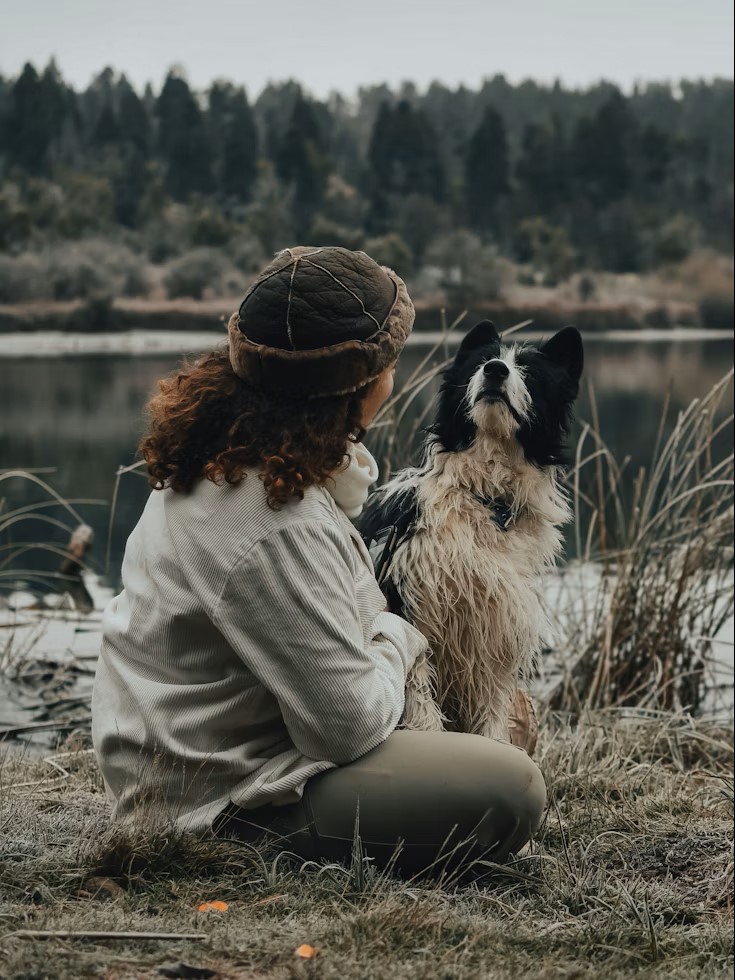
Can gazing into the eyes of an animal change our lives? This piece emerges from my PhD research on the transformative potential of eye contact between humans and other animals, grounded in relational and ecofeminist theory. Scholarship suggests that eye contact can deepen human-animal connection, unsettle anthropocentric worldviews, and influence individuals to rethink their ethical responsibilities to animals. My qualitative research with Australian “Animal People” echoes the power of the mutual gaze.
Emmanuel Levinas argued that the Face of the Other “speaks”, and eyes possess their own language (Levinas 1961/1980: 66). Building on this, Lori Gruen notes that we may encounter animals and still not “look them in the eye”; once we do, our relationships can change (Gruen 2013: 223–31). Sue Donaldson and Will Kymlicka similarly encourage us to “look into the eyes of an animal, to recognise the person there – familiar, yet mysterious, an independent locus of meaning and agency” (2011: 40). These are invitations to take seriously the possibility that animals look back, and that this looking back matters ethically and politically. In this framing, eye contact is not just a visual event but an embodied, relational practice. Drawing on Simone Weil, Iris Murdoch, Vinciane Despret and Elisa Aaltola, such moments can be understood as practices of with-ness, attention, or attentive love. They decentre the human, effect an unselfing, and invite us into animals’ worlds, their umwelten (Despret 2004; 2008; 2016; Aaltola 2018; Murdoch 1971; Weil 2009).
To explore how animal-human eye contact may influence pro-animal values and behaviours, I spoke with twenty young Australian Animal People: those who self-identified as having animal rights values, were vegan (or aspiring to be) and engaged in animal advocacy. Participants described moments of eye contact as leading to their recognition of animals as subjects of a life and morally equal, “like people”. Their recollections were rich: the texture of a cat’s gaze, the shock of meeting a pig’s eyes, a perceived sense of being “seen” by a snail. Some encounters were highly emotive. One participant described standing in a pig factory farm and feeling “persecuted in the eyes of an animal”, suddenly seeing herself from the pig’s perspective and feeling ashamed to be human. Others highlighted animals’ expressions of consent, comfort or reluctance, learning to respect boundaries and consider animals as agents and subjects. Participants commonly used the language of equality: “no difference”, “just like another friend”, “like they were human”. One traced this back to a childhood game of peek-a-boo with a puffin, another to her dog’s gesture of empathy when she cried, and another, to snorkelling with wild fish and turtles. These moments challenged their binaries of “them and us”. In their accounts, empathy was not an abstract moral virtue but a response to a specific relational event. Sharing a common reality with an animal helped them to consider, if I do not want to suffer, neither would you.
Eye contact not only shifted perceptions, it motivated action. Participants connected animal encounters not only to their pro-animal values, but to their movements towards veganism, and commitment to advocacy.
Adding to scholarship, my research suggests that interspecies eye contact can be a powerful tool for reimagining human-animal relationships. Paying attention to these moments helps to decenter the human, dissolve hierarchies, and encourage philosophies of multispecies ethics and equality. These embodied encounters, which must take place within respectful and consensual spaces, can influence pro-animal values and behaviours and lead to a growing population of Animal People. Ultimately, this may contribute to an end to systemic animal violence and exploitation.
Ondine Sherman is Co-Founder and Managing Director of Voiceless, the animal protection institute, and a PhD candidate at the University of Sydney, specialising in sociology and Critical Animal Studies. She has published five books, including Vegan Living and the Animal Allies fiction series (Sky, Snow and Star) and is the editor of magazine, Animail (Australasian Animal Studies Association). Ondine is also a director at Thrive Philanthropy.