By Annibal Gouvêa Franco
In late 2025, Annibal Gouvêa Franco and Ronaldo Guimarães Gouvêa published a founding manifesto [1]. In 2026, they expanded it in English as “Manifesto for Veganthropology (Vegan Anthropology)” [2], presenting Veganthropology as a normative descriptive, interspecies approach transversal to Sociocultural Anthropology.
Anthropology often operates within an implicit anthropocentric horizon. Veganthropology proposes another point of departure: antispeciesism and non exploitation become ethical framework and method, so nonhuman animals enter the scene as subjects of moral concern.
Its central analytical target is animal thingification, the institutional, practical, and discursive production of exploitable lives, commodification, and moral distance. The manifesto calls for an antispeciesist ethnography with public criteria, traceable data, and replicable procedures, open to independent audit.
This shift matters for the Social Sciences because it changes what counts as a social fact. By treating speciesism as structural, Veganthropology offers a vocabulary to analyze the institutional production of the edible, the usable, and the disposable as cultural social categories, not natural givens, and to reread power, morality, consumption, and violence through that lens. It helps explain how schools, markets, families, science, law, media, and everyday language normalize extraction, convert sentient life into property, and then present that conversion as common sense. It also expands comparative work, since speciesism can be studied alongside racism, sexism, and class domination through shared mechanisms of classification, distancing, routinization, and legitimation. Methodologically, it demands explicit positionality, so ethical commitments are declared instead of assumed.
The manifesto spatializes vegan practice across three interconnected planes: everyday life, intentional collective action, and digital territorialities. Everyday life is where veganism is lived and negotiated in routine frictions, including substitutions, refusals, avoidance strategies, and the management of commensality. Intentional collective action is where it is strategically projected toward shared goals and societal transformation, through public education, mobilizations, vigils, on the ground campaigns, denunciation practices, support networks, and mutual aid. Digital territorialities coordinate narratives and mobilization through campaigns, collaborative cartographies, and lexical disputes, bridging everyday practice and collective action.
As a program, the manifesto [2] sets four ethical foundations: justice for sentient beings; refusal of animal exploitation; recognition of ecological interdependence; and the moralization of consumption and habitus. It also defines alliance criteria: preserve animal centrality, keep an explicit abolitionist horizon, prevent agenda capture, and resist greenwashing and veganwashing.
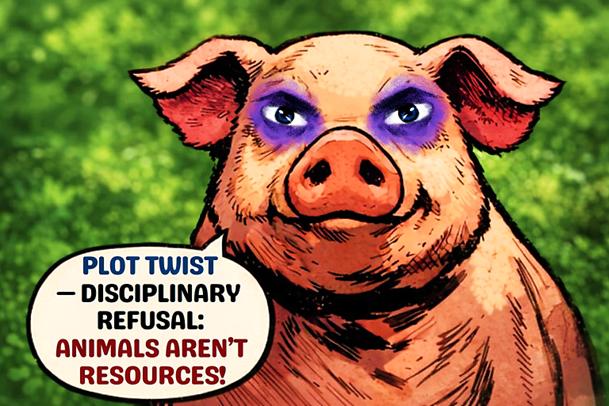
In closing, the text reads structural speciesism as a colonial continuity within the Plantationocene and calls for a teachable, researchable, accountable field. The disciplinary refusal is explicit: animals are no longer analyzable as resources.
PS: In 2026, Franco published a comic strip synthesizing the manifesto’s core ideas [3].
References
1 – FRANCO, A. G.; GOUVÊA, R. G. Manifesto por uma Antropologia Vegana: fundação de uma ciência social interespécies contra o especismo estrutural. Revista Sociedade Científica, 2025. DOI: 10.61411/rsc2025116718
2 – FRANCO, A. G.; GOUVÊA, R. G. Manifesto for Veganthropology (Vegan Anthropology): founding an interspecies social science against structural speciesism. Revista Sociedade Científica, 2026. DOI: 10.61411/eb2026rsc5
3 – FRANCO, A. G. Veganthropology: an ethical stance against structural speciesism (comic strip). Zenodo, 2026. DOI: 10.5281/zenodo.18274994
About the Author
Annibal Gouvêa Franco holds a Master’s degree in Design, Innovation and Sustainability (UEMG), a graduate certificate in Cultural and Social Anthropology, and is completing an undergraduate degree in Social Sciences. He researches Anthropology and Veganism, with an emphasis on Veganthropology, and is an Art teacher in the state education system (SEE/MG). Brazilian, based in Belo Horizonte, Minas Gerais, autistic (formerly diagnosed with Asperger’s), vegan for about 20 years.