By Jane McElligott
The book The Soul of an Octopus by Sy Montgomery and the Netflix documentary My Octopus Teacher won over the hearts of people captivated by the remarkable intelligence and complex inner lives of octopuses. The UK government has declared that octopuses are sentient beings capable of feeling pain and distress, extending legal protection to them under the Animal Welfare (Sentience) Bill (Royal Veterinary College, 2021).
Against this backdrop, the seafood company Nueva Pescanova’s announcement of plans to build the world’s first industrial octopus farm in the Canary Islands, Spain, sparked public outrage and fueled a global movement to ban commercial octopus farming before it gains a foothold. Legislatures in Spain, Chile, Mexico, and the United States are currently considering such bans (Langton, 2026).
In the United States, Washington State became the first state in March 2024 to pass a law banning commercial octopus farming and California followed closely behind, passing a similar ban in September 2024. In the wake of Washington and California’s bans, octopus farming bans are pending in seven other states: New York, Hawaii, New Jersey, North Carolina, Oregon, Massachusetts, and Connecticut (Langton, 2026).
At the federal level, Senators Lisa Murkowski of Alaska and Sheldon Whitehouse of Rhode Island introduced “The Opposing the Cultivation and Trade of Octopus Produced through Unethical Strategies” (OCTOPUS) Act, which would “ban commercial farming in the United States and prohibit imports of farmed octopus from foreign countries” (Animal Welfare Institute, n.d.).
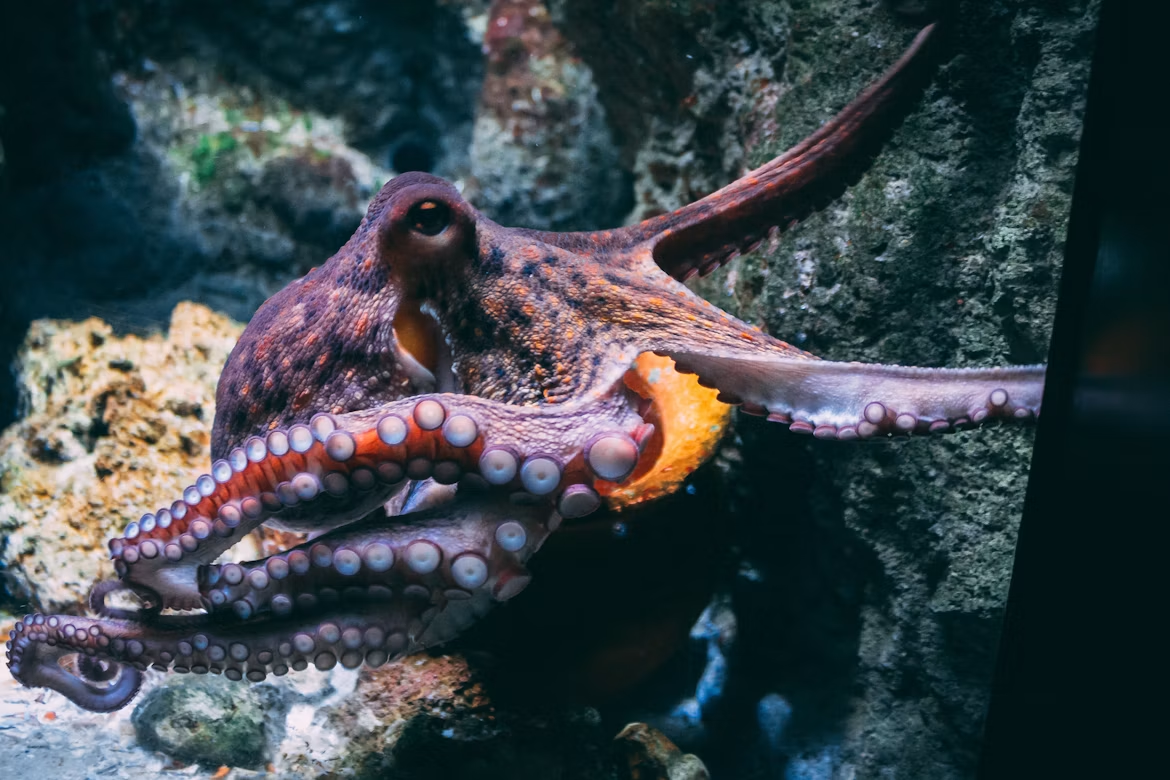
Octopuses are highly intelligent, sentient, and solitary creatures who cooperate with fish to hunt their food by cleverly navigating the ocean floor and reefs by “stealthily sticking their tentacles into crevasses to feel, taste, and flush out prey such as crustaceans, snails, and small fish” (Richter, 2024). For a brief video on the amazing intelligence and capabilities of octopuses, see: Why is the octopus brain so extraordinary?
Crowding octopuses into small, barren tanks would take a terrible toll on the mental and physical well-being of octopuses. Studies show that the mortality rate of octopuses in factory farms would likely approximate 50%, largely due to stress-induced cannibalism resulting from the “confinement of these naturally solitary animals in close quarters” (Langton, 2026). There is no “humane” form of slaughter for octopuses; proposed methods involve submerging octopuses in ice slurry while still alive, resulting in slow, painful deaths (Compassion in World Farming, 2023). The environmental impact of octopus farming is also a major concern, as wastewater from octopus farming facilities could introduce nitrates, phosphorus, antibiotics, pesticides, and other contaminants into surrounding marine ecosystems (Food Empowerment Project, n.d.).
Our Hen House has created a video detailing the movement to ban octopus farming at: A Wave of Change: Banning Octopus Factory Farms.
Jane McElligott is a Legal Studies Professor at Purdue University Global. She has a B.A. in History from University of Massachusetts Lowell, a J.D. Degree from Suffolk University Law School, and an MSCJ from Kaplan University. Jane is a Policy Volunteer for Humane World for Animals and is lucky to have four little dogs who are the best teaching assistants!