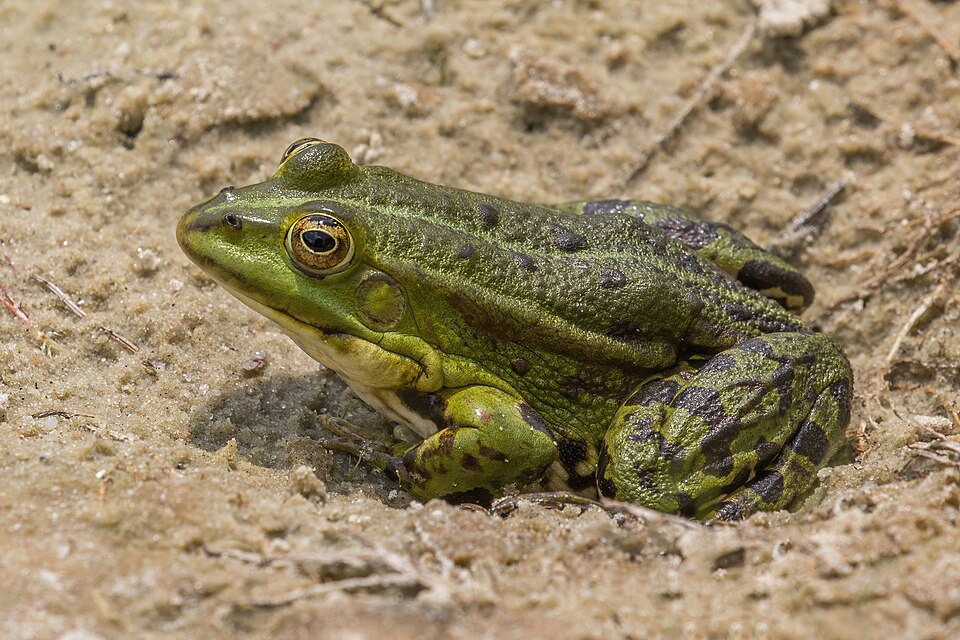
Photo Credit: Charles J. Sharp
Robert Rosenberger
Georgia Institute of Technology
I suggest that critics of the practice of educational animal dissection often fall into a trap. The convention of cutting up and examining the dead body of a frog or some other animal in biology class remains a commonplace classroom activity in precollege educational curricula in many places around the world. My observation is that in those places where it is common, such as the US and Canada, the discussion around this activity tends to take on particular shape. And it is one that stacks the deck against criticism.
Critics of animal dissection argue—rightly—that simulated alternatives have been shown in study after study to produce equal or better learning outcomes.1 And we argue—also rightly—that alternatives are better since they don’t involve the killing of millions of animals per year, as does the continued of practice of classroom dissection in many countries across the world.2 There are of course additional arguments as well.3
We all know that defenders of classroom dissection often respond by moving the goal posts. They counter that the crucial part of the dissection activity is actually its hands-on quality (as if there are not a multitude of other less problematic hands-on learning activities for which they could be advocating). They contend that the visceral and squishy encounter with a “real” animal specimen is important to biology education. And they argue that simulations can’t replicate these hands-on, real-life, natural features.
This sets the trap. It transfigures the conversation into one about how faithfully or not a simulation reproduces the exact same experience of cutting up a dead animal. For those just entering the discussion, such as students and parents still deciding how they feel about all of this, it would be easy to get distracted by these issues of simulation fidelity. That is, it is easy to accidentally allow the conversation to shift from concerns about learning and ethics to one about precisely how well or how poorly simulations recreate the exact experience of animal dissection.
When the discussion is allowed to reposition into one focused mainly on issues of simulation fidelity, this presents multiple advantages for those defending dissection. Not only does this pull attention away from issues of animal treatment and learning outcomes. It also puts the spotlight on one of animal dissection’s chief educational benefits: its hands-on interaction with a complex and viscerally impactful animal body. Critics of dissection are put in the unenviable position of trying to cast simulations as adequate to the task of mimicking the dissection activity. Defenders are teed up to pick apart any places where simulations do not recreate this same exact experience.
It is of course no easy task to argue against the prevailing setup of a discussion, especially when it has become as firmly set within culture as dissection has in some places in the world. This is why it is fully understandable that many critics of dissection attempt to argue for the adequacy of simulations, and to work to develop simulations further so that they can better mimic the experience of dissection. I have come to argue for a different strategy: We should attempt to identify and undermine the series of assumptions that make this setup possible. This is exactly what I try to do in my recent book, Against Frog Dissection: The Materiality Argument (Rosenberger, 2026, available free online). To do so, I draw on ideas from the fields of Science & Technology Studies and the philosophy of technology.
Here’s the move: I suggest that we should attempt to recast the dead animal itself as an educational tool, one to be contrasted with alternatives. That is, the dead animal itself, often a dead frog, is conventionally understood as the object of study, the target of the learning activity, the thing that students are learning about. It should instead be presented in these discussions for what it is: a classroom technology. It is a learning tool, the medium of the learning task, a “thing” altered by people in specific ways for specific purposes. It is, in part, a manmade artifact.
It would be understandable to worry that casting the dead frog as an educational tool could risk instrumentalizing and devaluing it; just the opposite. It is the conventional setup of the classroom dissection activity that does so. The conventional setup casts the dead animal as a natural object and as a scientific specimen, and, in so doing, smuggles in implications of innocence and objectivity. When instead properly understood as an educational tool, the dead-animal-for-dissection is emphasized as something altered by human hands. The inert corpse awaiting students in the classroom is not merely an encounter with a part of nature, not merely a specimen, not merely an object of study. It is the remains of an animal that was captured from the wild, preserved, shipped, sold and purchased, and presented ready-made to students in the context of a faux experimental setting. It is something that was killed.
There may be strategic value to reconceiving classroom dissection this way. If we can recast the dead animal in this scenario as a technology—that is, if we can highlight how this animal has been remade into an educational tool—then this could defuse some of the defenses of this practice. This could help to unstack the deck set against criticism.
In particular, by emphasizing the dead animal’s status as an artifact (as something killed and changed and remade for this classroom learning activity) we can disarm defenders’ claims that it is something real, or is an encounter with nature. It is not these things, or at least not merely so. By highlighting its status as an educational tool, as the medium of the lesson and not the lesson itself, this underscores the pedagogical choice being made. It emphasizes that a choice can be made otherwise.
We can note that the reformulation that I propose still leaves one of animal dissection defenders’ core arguments standing: namely that an advantage of animal dissection over computer-simulated alternatives is its hands-on quality. I’ve always thought this was both a strong and also very weak argument. It is strong in that it is true that animal dissection provides a hands-on educational experience that is visceral and memorable, that hands-on educational experiences are a good thing, and also that computer simulations of dissection really cannot replicate this particular quality very well (although physical simulations do).4 However, it is also exceptionally weak because, as noted, there are many classroom activities that provide hands-on educational experiences, not just this one. That is, this hands-on experience is neither exclusive nor special to animal dissection. We can be advocates for hands-on educational activities and still maintain that this particular hands-on activity should be abandoned.
And here’s the important point: within conventional animal dissection discussions, the hands-on argument only seems strong exactly because it is often assumed that animal dissection is the ideal. That is, it is often assumed that any alternatives must mimic this exact activity as closely as possible. When the animal-for-dissection is recast as an educational tool, a choice among others, this upends this assumption that it is an ideal that must be copied. The choice between dissection and its alternatives is reset as a one between different classroom tools, each with their own educational advantages and limitations. And dissection’s disadvantages include, and are not limited to, its moral problems.
What’s next for work in this line of thinking on animal dissection? One issue raised here is the pervasiveness of assumptions about this precollege classroom activity. An open avenue for empirical research is into what I’ve been referring to here as the conventional discussion (or what in the book I outline in more detail as “the Dissection Paradigm.”) It is an open question just how strongly these assumptions hold in different areas across the world where the dissection activity prevails. It is an open question too whether the strategies for recasting of this activity for which I am advocating here can make any progress in uprooting these assumptions.
These ideas also open the door to another question for further research: What can dissection simulation become when it is unshackled from the expectation that it must attempt to produce as closely as possible the experience of cutting up an animal? I offer an extended brainstorm on this issue in the book. But, this is an open issue for exploration, one that contemporary simulation developers are taking up.5
This debate over animal dissection can sometimes appear to be a decision between two competing values: the educational value of dissecting an animal on the one side, and the ethical value of refraining from dissection on the other. However, when we explicitly reconceive the dead animal as an educational technology, we can see the situation more clearly for what it actually is: a choice among pedagogical tools, tools that teach the same lessons at least equally well, and each with its own advantages and limitations. But only one of these options, the animal dissection activity, comes saddled with moral problems.
Notes
- For systematic reviews of the literature, see: Zemanova and Knight, 2021; Ormandy et al., 2022.
- For example, the American Anti-Vivisection Society estimates that six million vertebrate animals are used in precollege dissection each year in the United States alone.
- For my favorite review of these issues, see (Oakley, 2013).
- See, for example, SynDaver’s SynFrog Dissection Model: https://syndaver.com/product/synfrog-frog-dissection-model/
- See, for example:
Embibe’s Froggipedia App: https://www.embibe.com/exams/froggipedia/
Visible Body Suite’s 3D interactive frog model: https://www.visiblebody.com/blog/how-to-teach-with-visible-biologys-dissectible-virtual-frog-model
Biosphera’s 3D Frog Anatomy: https://biosphera3d.com/product/3d-frog-anatomy-software/
References
Oakley, Jan. (2013). Animal Dissection in Schools: Life Lessons, Alternatives and Humane Education [Policy paper.]. Ann Arbor, MI: Animals and Society Institute. Available online at: http://www.animalsandsociety.org/research/digital-archive/
Ormandy, Elizabeth, Janella C. Schwab, Samantha Suiter, Nicole Green, Janice Oakley, Pamela Osenkowski and Christine Sumner. (2022). “Animal Dissection vs. Non-Animal Teaching Methods: A Systematic Review of Pedagogical Value.” The American Biology Teacher. 84 (7): 399–404.
Rosenberger, Robert. (2026). Against Frog Dissection: The Materiality Argument. Cham: Palgrave Millan. Available online at: https://link.springer.com/book/10.1007/978-3-032-14346-4
Zemanova, Miriam A., and Andrew Knight. (2021). “The Educational Efficacy of Humane Teaching Methods: A Systematic Review of the Evidence.” Animals. 11: 114.
Robert Rosenberger is a philosopher of technology at Georgia Tech in the Jimmy and Rosalynn Carter School of Public Policy. His books include Callous Objects: Designs Against the Homeless, Distracted: A Philosophy of Cars and Phones, and Against Frog Dissection: The Materiality Argument.